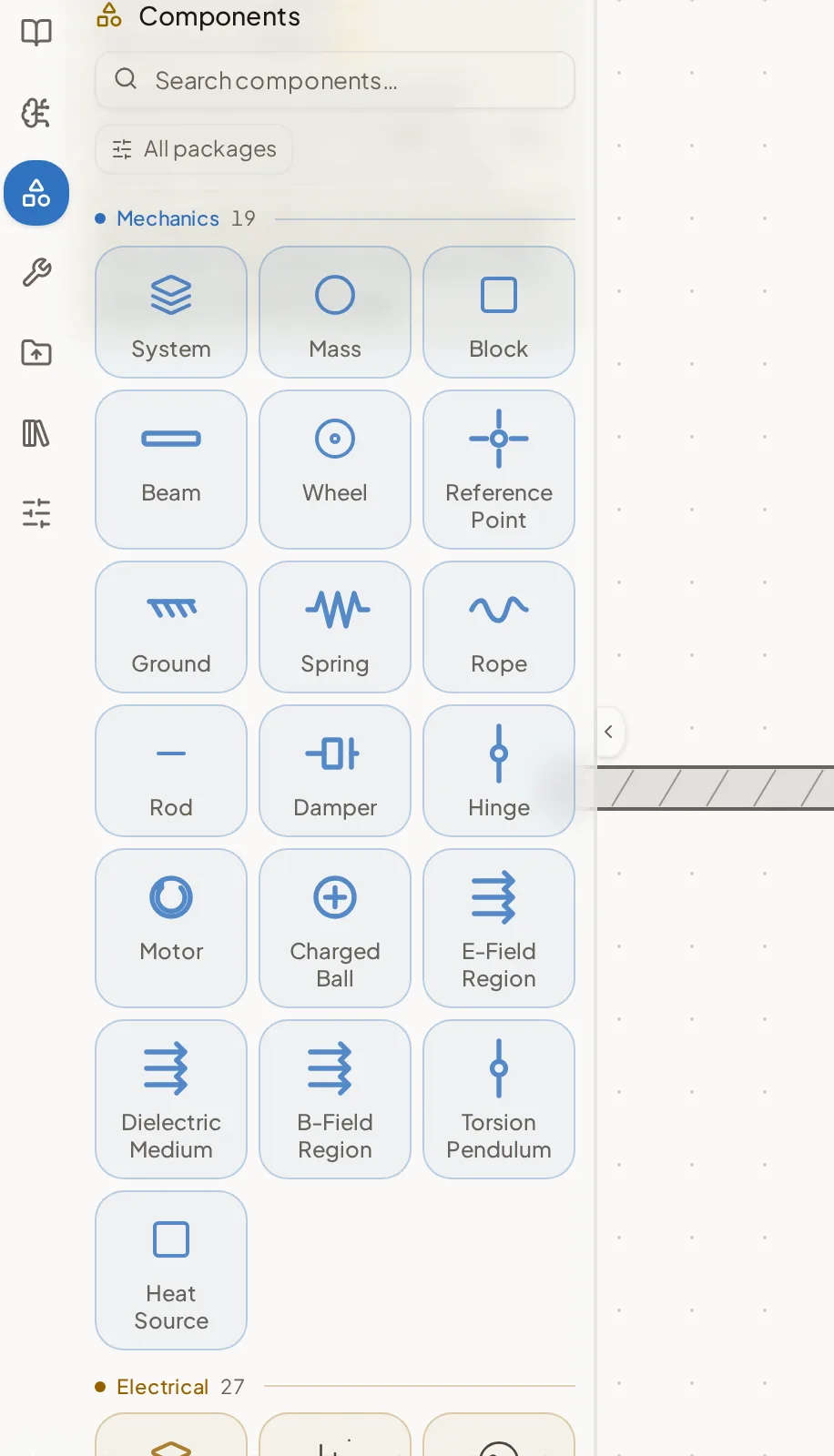
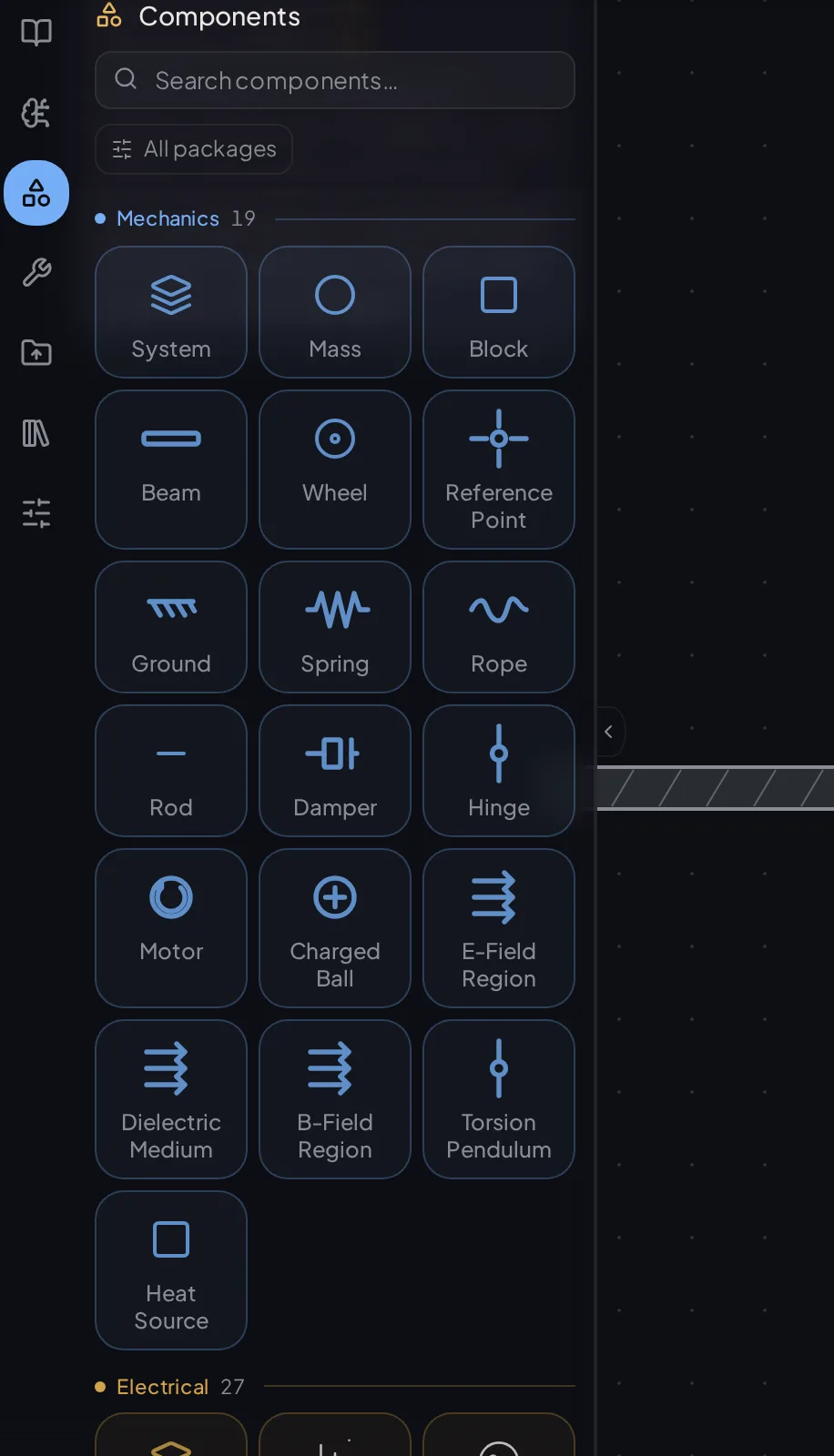
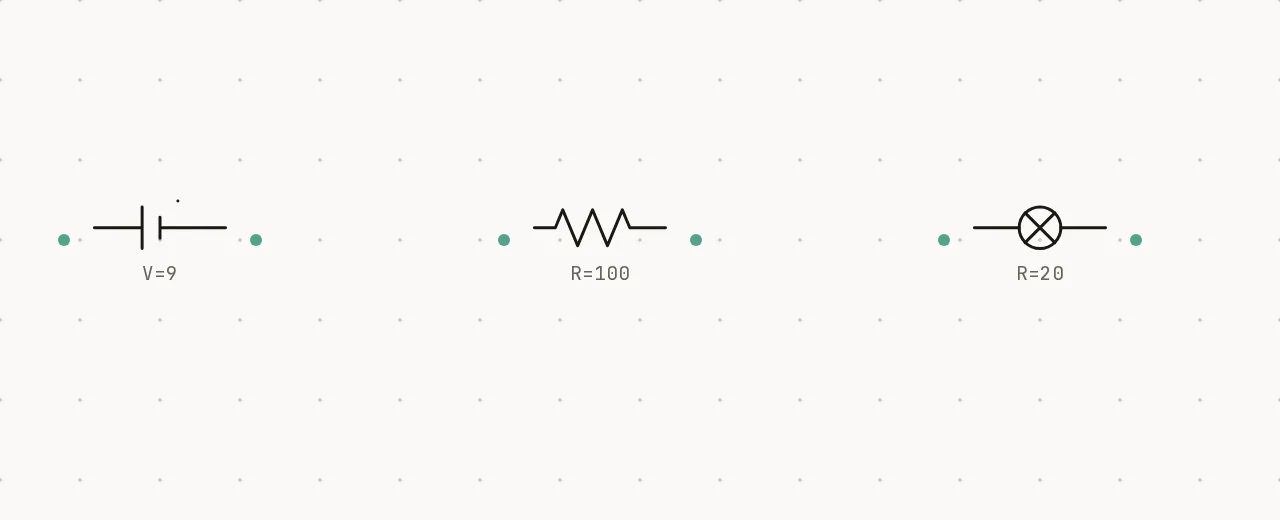
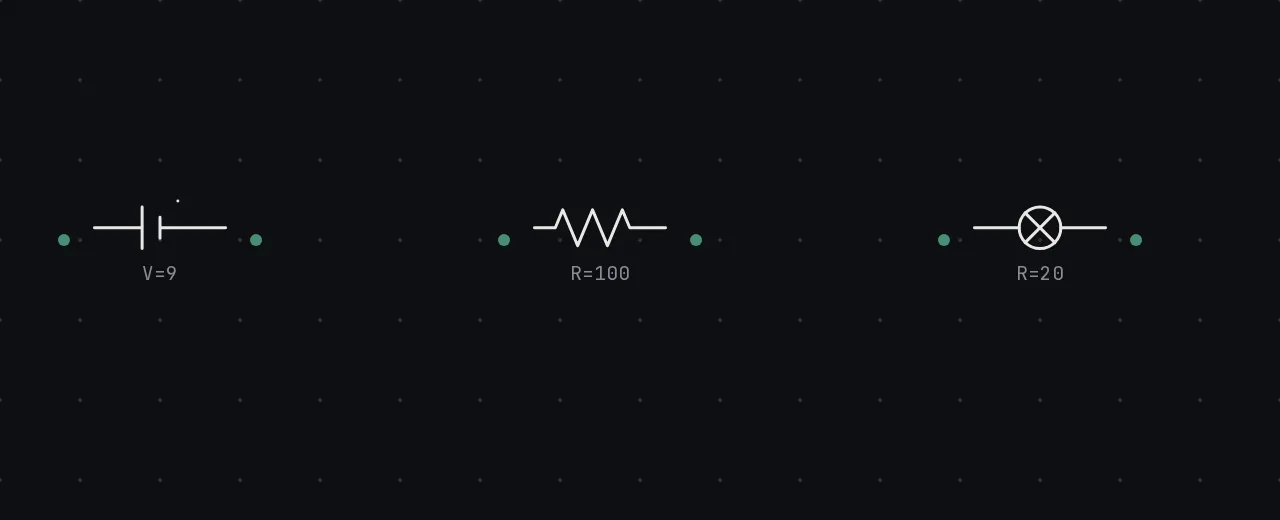
Generated from the behavior registry — the same table the Add Behavior menu, the world builder and the AI importer read. A few are registered but await their solver; those are marked.
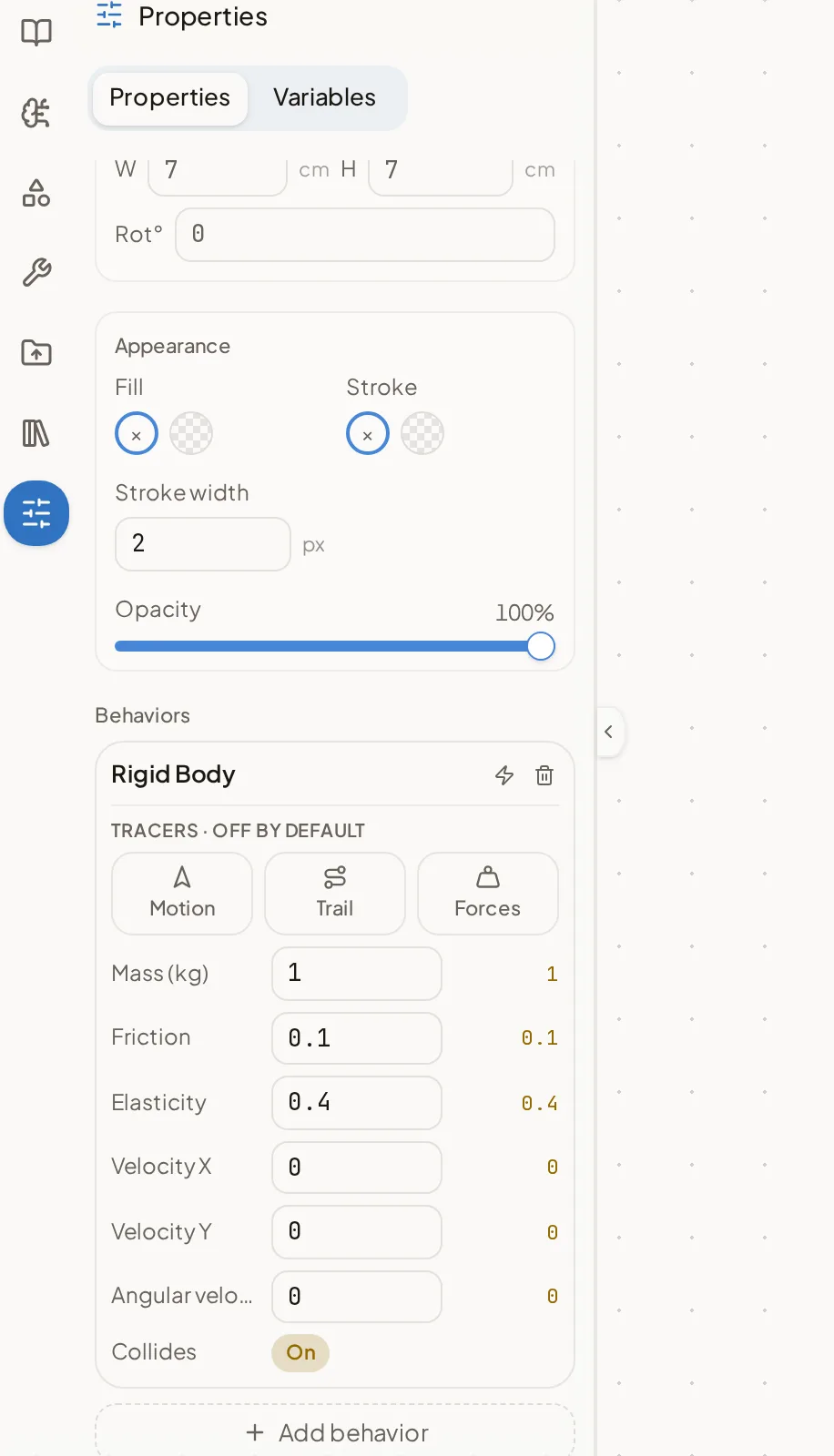
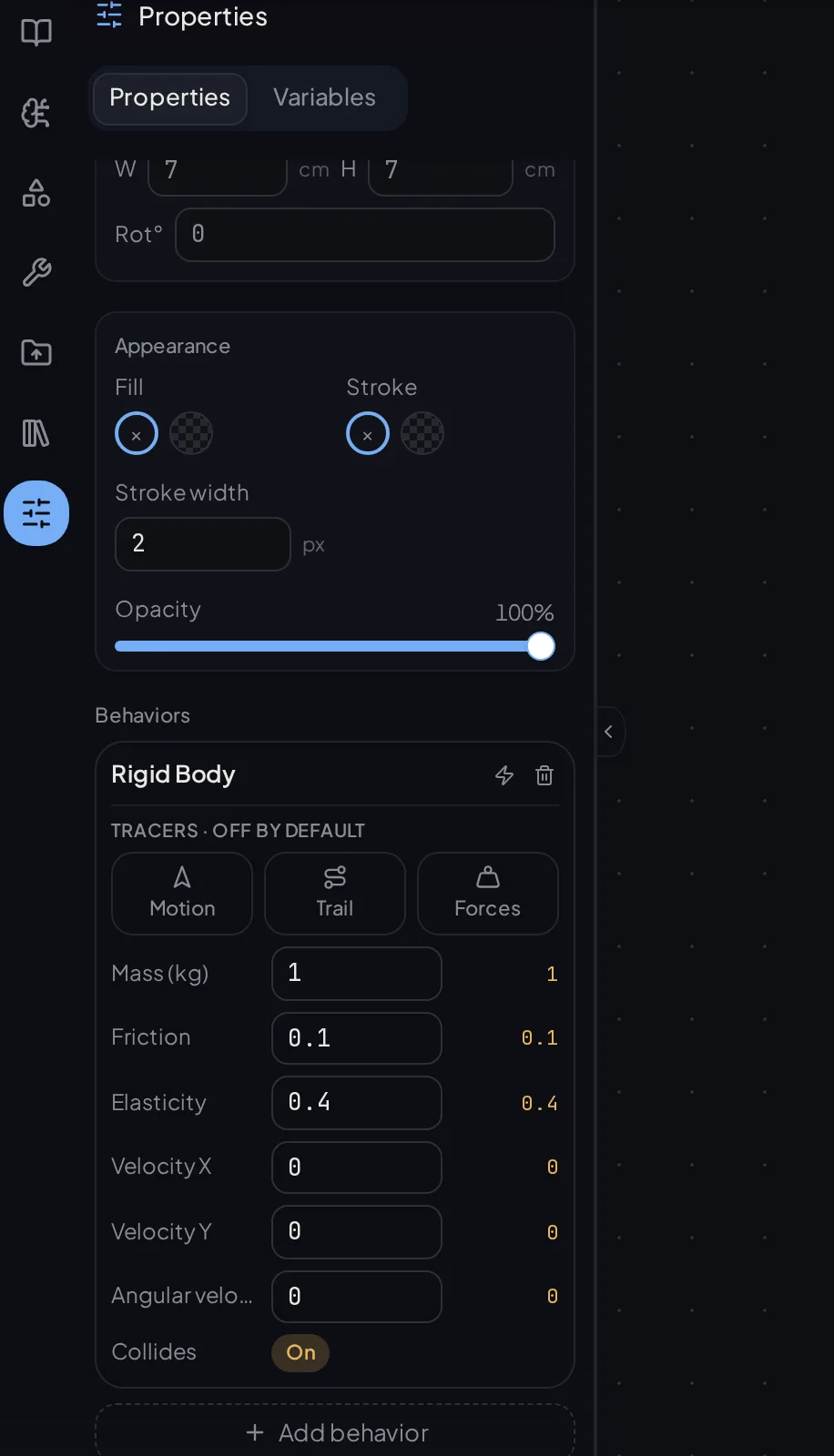
Rigid BodyrigidBody
Mass, collisions, gravity — the shape becomes real.
Parameters: Mass (kg) · Friction · Elasticity · Velocity X · Velocity Y · Angular velocity · Collides with bodies (0/1) · Tracer: motion vectors (0/1) · Tracer: path trail (0/1) · Tracer: force arrows (0/1)
Static BodystaticBody
Immovable collider — ground, wall, anchor.
Parameters: Friction · Elasticity
Springspring
Connects whatever its two endpoints touch.
Parameters: Stiffness k · Damping · Rest length ×
Roperope
Flexible link at fixed length.
Parameters: Damping
Rigid Rodrod
Inextensible link — pendulum arms, linkages.
Damperdamper
Dashpot — resists relative motion.
Parameters: Damping
Hingehinge
Revolute joint — pins the bodies under it (or one body to the world).
Motormotor
Drives this body’s rotation at a target speed.
Parameters: Speed (rad/s)
Force Fieldforce
fx / fy expressions applied every frame (can use t and variables).
Parameters: Force X · Force Y
Wirewire
Conductor — joins the circuit terminals it touches.
Electrical NodeelectricalNode
Participates in the circuit solver (disable to take it offline).
Point Chargecharge
Coulomb force with other charges, plus qE / qv×B inside field regions.
Parameters: Charge (µC)
Electric Field Regionefield
Uniform E field inside this region — accelerates charges (F = qE).
Parameters: Ex (N/C) · Ey (N/C)
Magnetic Field Regionbfield
Uniform B field (out of the page) — deflects moving charges (F = qv×B).
Parameters: Bz (T)
Dielectric Mediumdielectric
Syllabus §2.7/§2.9: relative permittivity of the region. With a surface charge density σ it solves the parallel-plate case for real — E = σ/(ε₀εr), D = σ, and energy density u = ½εE² in SI units, not pedagogical ones.
Parameters: Relative permittivity εr · Surface charge density σ (µC/m²) · Relative permeability μr
Torsion SpringtorsionSpring
On a hinge — angular restoring torque toward a rest angle (torsion pendulum).
Parameters: Stiffness κ · Rest angle (deg)
Heat SourceheatSource
Injects/removes power (W); conducts to touching bodies; cools toward the page’s `ambient` variable. Power=0 turns a body into a plain conductor/thermometer.
Parameters: Power (W) · Conductivity k · Cooling rate · Initial temp (°C)
Sensorsensorsolver pending
Measurement region — graphs & triggers on the roadmap.
Light SourcelightSource
Coherent source (laser). Rotate to aim; λ drives the ray tint AND the real interference math downstream — canvas scale is 1 px = 1 µm.
Parameters: Ray count · Beam width (µm) · Wavelength λ (nm)
Thin LensthinLens
Paraxial thin lens (1/v − 1/u = 1/f). Place the source beyond 2f, at 2f and inside f to walk the classic imaging cases; negative f diverges.
Parameters: Focal length f (px)
MirroropticalMirror
Specular reflection off this line.
ScreenopticalScreen
Detector. Marks ray hits; behind a slit it shows the computed diffraction/interference intensity, and in Play photons accumulate one by one (Born rule).
Slitslit
Young's mask at real scale (1 px = 1 µm). Defaults are the classic d = 40 µm, a = 12 µm double slit — fringe spacing Δy = λL/d shows on the screen.
Parameters: Slit width a (µm) · Slit count (1 or 2) · Slit spacing d (µm)
Wave SourcewaveSource
Uniform plane wave along its rotation. Set εr/μr/σ for the three syllabus media: lossless dielectric (σ=0), lossy (σ>0, decaying envelope) and good conductor (skin depth).
Parameters: Frequency f · Amplitude E0 (px) · Medium εr · Medium μr · Medium σ (0 = lossless)
Wave BoundarywaveBoundary
Normal-incidence interface (air→glass with the εr2=4 default): reflection Γ, transmission τ and the standing-wave ratio, exactly as derived in class.
Parameters: Frequency f · Medium 1 εr · Medium 1 μr · Medium 1 σ · Medium 2 εr · Medium 2 μr · Medium 2 σ
Transmission LinetransmissionLine
Lossless line — Z0, load and electrical length determine Zin, Γ and the standing-wave pattern.
Parameters: Z0 (Ω) · Load R (Ω) · Load X (Ω) · Length (× λ)
Quantum WellquantumWell
Particle-in-a-box: ψn, |ψn|² and En = n²h²/8mL². Step n to watch nodes appear and levels spread as 1/L² — the canonical confinement experiment.
Parameters: Quantum number n · Well width L
Tunnel BarriertunnelBarrier
Rectangular barrier: T and R from the Schrödinger solution. With E < V0 the particle still gets through — sweep E/V0 and barrier width to map tunneling.
Parameters: Particle energy E · Barrier height V0 · Barrier width L